The Role of Mnemonic Devices in Improving Puzzle Solving Efficiency
Unlocking the Power of Mnemonic Devices
In our fast-paced world, where information overload is commonplace, individuals often find themselves grappling with memory retention and the art of problem-solving. Fortunately, mnemonic devices have emerged as a powerful ally in enhancing cognitive functions, allowing individuals to navigate challenges with greater ease and confidence. These clever memory aids not only improve recall but also refine the thought process when faced with complicated tasks.
Diverse Forms of Mnemonics
Mnenomics come in a variety of formats, catering to different learning preferences and cognitive needs. Here are some notable examples:
- Acronyms: One of the simplest forms of mnemonics involves creating acronyms using the first letters of a list. For example, “HOMES” represents the five Great Lakes in North America: Huron, Ontario, Michigan, Erie, and Superior. This technique is particularly effective for students learning geography or anyone needing to recall a list quickly.
- Rhymes: Leveraging rhythmic patterns can make information more memorable. For instance, the saying “Thirty days hath September, April, June, and November” helps people remember the months with fewer than 31 days. Such rhymes not only stick in the mind but can also add a layer of enjoyment to the learning process.
- Visualization: This technique involves creating vivid mental images associated with the information being learned. For example, if someone needs to remember to buy apples, bread, and milk, they might visualize a giant apple wearing a loaf of bread for a hat, while holding a carton of milk. This quirky image helps connect the items and aids in recall.
The Impact of Mnemonics on Problem Solving
The advantages of utilizing mnemonic devices are profound. Studies indicate that employing these techniques can enhance memory retention rates by as much as 80%. This high efficiency is not confined to academic settings alone; it extends into leisure activities like Sudoku, crossword puzzles, and logic games, where quick and accurate recall is essential for success.
As puzzle enthusiasts and problem solvers seek ways to improve their skills, incorporating mnemonic devices into their practice can help them gain a competitive edge. By simplifying complex information and aiding recall, these memory aids transform daunting challenges into manageable tasks, making problem-solving not just easier but also more enjoyable.
Embrace Mnemonics for Success
By embracing mnemonic devices, individuals open doors to a world of enhanced cognitive abilities. The act of learning and solving puzzles becomes not only a mental exercise but also a delightful journey of creativity and ingenuity. As you explore different mnemonic strategies, you may discover your unique methods that resonate with your problem-solving style. Whether you are a student, a professional, or simply a puzzle lover, these memory aids can effectively unlock your potential in the fascinating realm of puzzles and beyond.
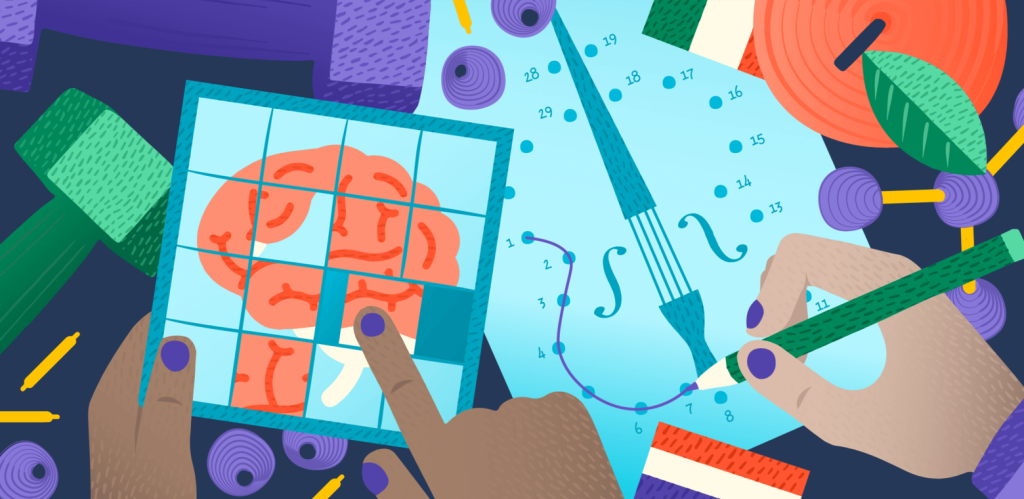
DIVE DEEPER: Click here to discover how brain teasers can enhance children’s memory!
Enhancing Cognitive Abilities Through Mnemonic Techniques
Mankind’s relentless pursuit of knowledge often collides with the inherent limitations of human memory. As puzzle-solving aficionados, we continuously seek strategies to sharpen our cognitive skills. This quest leads us to explore the transformative role of mnemonic devices in bolstering efficiency during puzzle solving. By serving as cognitive shortcuts, mnemonics are more than mere memory aids; they are powerful tools that help streamline thought processes, enabling solvers to tackle challenges with enhanced clarity.
In the realm of puzzles, whether it be crosswords that challenge linguistic prowess or logic games that demand analytical reasoning, the efficiency of solving often hinges on one’s ability to recall pertinent information swiftly. Integrating mnemonic devices into this equation can elevate a novice’s skills to a proficient level, maximizing problem-solving potential. Here’s how various mnemonic strategies can specifically aid in enhancing puzzle-solving efficiency:
- Chunking: This method involves breaking down larger sets of information into smaller, manageable units. For instance, when trying to memorize complex patterns or sequences needed for Sudoku, chunking can help solvers remember specific rows or columns as distinct sets rather than overwhelming blocks of numbers.
- Storytelling: Crafting narratives around seemingly unrelated puzzle components can create meaningful connections, aiding retention. Consider a challenging crossword clue—by inventing a story that links the clue’s answer to familiar contexts or personal experiences, the answer becomes easier to recall during gameplay.
- Method of Loci: This ancient technique utilizes visualization and spatial memory. Solvers can envision placing puzzle pieces or clues along a familiar path in their home, mentally ‘walking’ through it to retrieve information. This method is particularly advantageous in complex puzzles that require remembering multiple elements simultaneously.
The psychological foundations supporting the effectiveness of these mnemonic devices are equally compelling. Research in cognitive psychology suggests that engaging multiple areas of the brain through these techniques fosters deeper connections and greater recall ability. Consequently, as puzzle enthusiasts employ these strategies, not only do their memory functions improve, but their overall problem-solving strategy also grows more sophisticated.
For individuals diving into the intricacies of logic puzzles or the delightfully intricate world of crosswords, the ability to effectively harness mnemonic devices can turn a frustration-laden experience into a triumphant one. Imagine you’re faced with an impossible crossword clue. By using mnemonic techniques, recalling related words or associated meanings becomes less about rote memorization and more about intuitive connections formed through creative thought processes. In this way, puzzles evolve from mere tasks into engaging challenges that stimulate the mind and enhance our enjoyment of the activity.
The Impact of Mnemonic Devices on Cognitive Processes
Mnemonic devices play a transformative role in enhancing cognitive efficiency, particularly when it comes to solving puzzles. By leveraging memory aids, individuals can significantly improve their ability to retain information and retrieve it when needed. The human brain often struggles with recalling vast amounts of data, especially in complex puzzle scenarios. This is where mnemonics shine, providing a structured method to encode information into meaningful patterns.For instance, utilizing acrostics can enhance recall of sequences, like remembering the order of operations by using a phrase such as “Please Excuse My Dear Aunt Sally.” This simple memory trick not only aids in improving immediate task performance but also allows individuals to engage with puzzles more strategically. Moreover, visual mnemonics, which involve associating images with concepts or pieces of information, can vastly improve problem-solving skills. Through a technique commonly known as the method of loci, individuals visualize a familiar location and mentally place each puzzle piece within that context. This approach harnesses the brain’s natural spatial memory, making the retrieval of puzzle pieces more intuitive and efficient.
Mental Training and Strategy Formulation
Beyond immediate recall, mnemonic devices contribute to the formulation of broader strategies in puzzle-solving. By using these devices, individuals become proficient at breaking down complex problems into smaller, manageable parts. This segmentation allows for a more organized approach, reducing cognitive overload and enhancing focus.Relying solely on brute force and memorization can lead to confusion and frustration. In contrast, mnemonic strategies create a framework for anticipation and planning. For example, chess players often use mnemonic devices to remember opening strategies or key positions. Such techniques not only benefit seasoned players but also beginners learning the game.These memory enhancements cultivated through mnemonics can extend beyond puzzles into various fields such as mathematics, programming, and language learning. By adopting these strategies, individuals open themselves to a world of cognitive growth and effective problem-solving, harnessing the full potential of their mental capabilities. As we explore these various mnemonic devices, the potential for improving puzzle-solving efficiency illustrates the profound connection between memory aids and cognitive performance.
| Mnemonic Device Type | Advantages in Puzzle Solving |
|---|---|
| Acronyms | Facilitates quick recall of complex terms or steps |
| Visual Mnemonics | Enhances retention through imagery, aiding information retrieval |
By understanding and employing these mnemonic devices, enthusiasts and hobbyists alike can turn puzzling challenges into manageable tasks—improving overall efficiency in solving them. Further exploration into each technique will reveal even broader applications and benefits in all areas of cognitive activity.
DISCOVER MORE: Click here to learn about the link between memory and neuroplasticity
Practical Applications of Mnemonic Devices in Puzzle Solving
When it comes to practical applications, mnemonic devices provide puzzle solvers with valuable strategies that can be immediately integrated into their everyday approaches. As casual gamers or seasoned enthusiasts engage with various types of puzzles, the conscious application of these techniques not only enhances their performance but also deepens their appreciation for the nuances of such challenges. Here are a few compelling examples demonstrating the efficacy of mnemonics in puzzle solving:
- Acronyms and Acrostics: These techniques simplify the memorization of lists or sequences. For instance, when solving word puzzles that require recalling a specific series of letters or terms, one might create an acronym or an acrostic involving the initial letters of the words needed. For example, the term “HOMES” can help individuals remember the Great Lakes: Huron, Ontario, Michigan, Erie, and Superior. Such associations enable solvers to swiftly connect the dots and retrieve necessary information.
- Visualization Techniques: Strong visual images often facilitate the retention of complex information. In a number-based puzzle, like KenKen, visualizing a giant three-dimensional cube can help solvers better remember patterns and relations between numbers. This approach transforms numerical sequences into vivid stories that allow for quicker recall when tackling tough challenges.
- Rhymes and Alliteration: Creative wordplay in the form of rhymes or alliterative phrases often entertains while it educates. Think of a phrase you might associate with a tricky crossword answer like “Don’t Forget Pie” to help remember the digits of pi (3.14). The rhythm and musicality of these devices can enhance memory retention, making them essential tools in the puzzle-solving toolkit.
Additionally, the social aspect of puzzles can be enriched through communal use of mnemonics. Group activities such as trivia nights or puzzle competitions often benefit from team-based mnemonic strategies. Participants can collectively brainstorm acronyms or visual mnemonics that leverage each member’s strengths. This collaborative environment not only promotes deeper engagement but fosters collective memory enhancement, further boosting efficiency in solving complex puzzles.
Research underscores that the use of mnemonic devices can lead to significant improvements in efficiency. According to a study published in the Journal of Experimental Psychology, participants tasked with recalling information utilized mnemonic strategies, achieving recall rates as high as 85% compared to an average of 25% for those relying solely on traditional memory techniques. Such compelling statistics demonstrate how encompassing mnemonic devices into one’s puzzle-solving repertoire can serve as a game-changing practice, propelling average solvers into extraordinary realms of performance.
Furthermore, embracing technology can amplify the benefits of mnemonic devices. Puzzle-focused applications and online platforms often feature integrated mnemonic tools or community-generated resources to facilitate collective memory techniques. A puzzle app could, for instance, suggest mnemonic enhancements for crosswords, or provide flashcards with acronyms for logic games, merging modern technology with ancient memory practices.
Ultimately, by utilizing mnemonic devices in their puzzle-solving journeys, enthusiasts can not only improve their efficiency but also engage more deeply with the puzzles they love. The art of memory, when interwoven with the joy of challenges, transforms each puzzle into a realm of discovery and cognitive enhancement, inviting solvers to further explore the fascinating connections between memory and problem-solving.
DIVE DEEPER: Click here to learn more
Conclusion: Unlocking the Potential of Mnemonic Devices
In summary, mnemonic devices are not merely clever memory tricks; they are powerful tools that significantly enhance puzzle solving efficiency and enjoyment. Through techniques such as acronyms, visualization, and creative wordplay, solvers can simplify complex information, making it easier to recall during challenging puzzles. These methods foster not only faster processing but also a deeper engagement with the materials at hand, transforming the puzzle-solving experience into one of discovery and excitement.
The compelling data presented, including recall improvements of up to 85% for those utilizing mnemonic strategies, underscores the remarkable effectiveness of these techniques. As puzzle enthusiasts incorporate mnemonics into their routines—whether playing solo, teaming up with friends during trivia night, or participating in online competitions—they not only elevate their problem-solving skills but also build a sense of community through shared strategies. The fusion of technology with mnemonic practices further enriches this endeavor, providing a modern, adaptive approach to mastering puzzles.
Ultimately, mnemonic devices redefine the landscape of puzzle solving, inviting hobbyists and serious solvers alike to explore the intricacies of memory and cognitive function. By harnessing the power of mnemonics, one can embark on a more rewarding and efficient journey through the myriad challenges puzzles present, transforming each engagement into a stimulating cognitive adventure. The ongoing interplay between memory techniques and puzzle-solving will undoubtedly continue to unfold, beckoning individuals to dive deeper into this captivating realm of intellectual engagement.
Related posts:
The Connection Between Memory Challenges and Neuroplasticity in Adults
How Brain Teasers Improve Working Memory in Children
How Jigsaw Puzzles Enhance Cognitive Flexibility and Memory
Exploring How Memory Games Can Combat Age-Related Decline
The Influence of Memory-Boosting Apps on Daily Cognitive Performance
The Effect of Memory Cards on Long-Term Recall Abilities

Linda Carter is a writer and puzzle expert specializing in mind games, brain teasers, and cognitive challenges. With extensive experience helping individuals enhance their problem-solving skills and think critically, Linda shares her knowledge on our platform. Her goal is to empower readers with practical advice, engaging puzzles, and strategies to sharpen their minds and achieve success in the captivating world of mind games and puzzles.